New therapy boosts bone growth in dwarfism
What's the child health challenge?
Achondroplasia is the most common type of dwarfism, affecting about one in 25,000 babies born in Australia. Unfortunately, children with achondroplasia are 50 times more likely to die before the age of five than children without the condition.
Achondroplasia is caused by a fault in the FGFR3 gene and slows bone growth in children’s limbs, spine and the base of their skull.
Apart from short stature, people with achondroplasia can experience painful spinal, leg, and hip problems which may require surgery. Other complications include spinal cord compression, sleep apnoea, bowed legs, spinal stenosis and recurrent ear infections. People with achondroplasia are at risk of these complications throughout their lives.
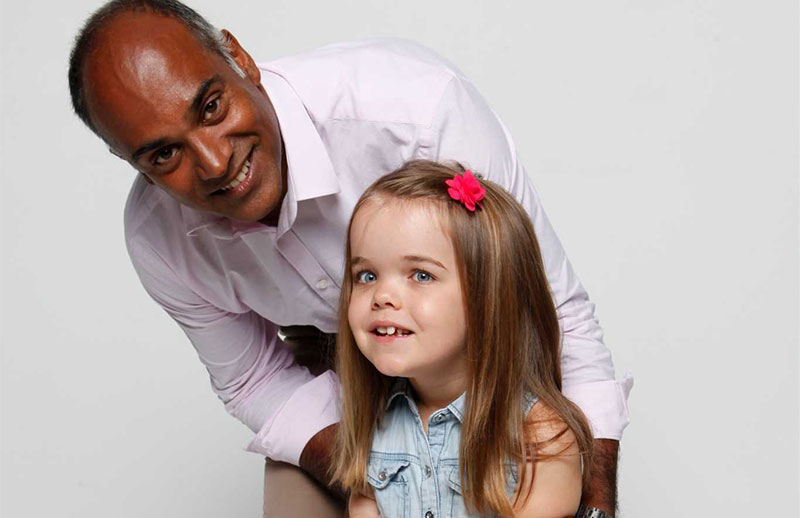
Image: Professor Ravi Savarirayan with a patient
What's the child health challenge?
Achondroplasia is the most common type of dwarfism, affecting about one in 25,000 babies born in Australia. Unfortunately, children with achondroplasia are 50 times more likely to die before the age of five than...
What's the child health challenge?
Achondroplasia is the most common type of dwarfism, affecting about one in 25,000 babies born in Australia. Unfortunately, children with achondroplasia are 50 times more likely to die before the age of five than children without the condition.
Achondroplasia is caused by a fault in the FGFR3 gene and slows bone growth in children’s limbs, spine and the base of their skull.
Apart from short stature, people with achondroplasia can experience painful spinal, leg, and hip problems which may require surgery. Other complications include spinal cord compression, sleep apnoea, bowed legs, spinal stenosis and recurrent ear infections. People with achondroplasia are at risk of these complications throughout their lives.
Image: Professor Ravi Savarirayan with a patient
What's the discovery or innovation?
Vosoritide is a drug that contains a natural human protein and is used to stimulate bone growth in paediatric patients with achondroplasia.
Findings by researchers at Murdoch Children’s Research Institute (MCRI), the largest Vosoritide clinical trial site in the world, successfully showed the life-changing benefits for children with achondroplasia. Thanks to this research, Vosoritide was added to the Australian Pharmaceutical Benefits Scheme (PBS) in 2023 and is expected to benefit at least 140 children every year.
Professor Ravi Savarirayan pioneered the vital research that led to the addition of Vosoritide to the PBS. Professor Savarirayan also led 55 clinicians from 16 countries to create the first global standards to help diagnose and manage achondroplasia. The consensus statement has helped to standardise and improve health outcomes and quality of life for children with achondroplasia, while providing a platform for further research.
Research by MCRI has shown Vosoritide may also reduce the chances of needing surgery, sudden infant death syndrome (SIDS) and sleep apnoea for children with achondroplasia.
In other international trials, our researchers found children treated with Vosoritide grew an average of 1.57 centimetres per year more than those who received the placebo (no treatment). The therapy also boosted bone growth at a rate almost equivalent to that of children of the same age without the condition. In these trials, we confirmed Vosoritide was safe to give to children from birth to 18 years with dwarfism.
Professor Savarirayan’s team is also leading trials of two other precision therapies for achondroplasia and a range of other inherited genetic skeletal conditions, with the hope of improving the lives of children affected by them. During these trials, our researchers have found that the oral drug infigratinib is effective at increasing height and improving proportional limb growth in children with achondroplasia from ages three to 11 years. This drug could meet the need for an oral medication for those with achondroplasia, which is especially important for children in parts of the world where oral medications are more practicable than injections.
How is it changing children’s lives?
Vosoritide has a positive everyday impact on the quality of life and social functioning of children with achondroplasia. Many children who take Vosoritide have an increased access to environments and may be more independent.
Recent research has also found that Vosoritide treatment can increase height, facial volume and the size of the foramen magnum (the hole at the base of the skull that connects the brain with the spinal cord) in children under five with achondroplasia, with no serious side effects. In addition, recent evidence has shown it to improve the quality of life of patients on treatment, as assessed by validated tools. We hope these findings will improve health outcomes by reducing medical complications and surgery and improve functionality.
By identifying drugs that improve skeletal growth rather than purely treating achondroplasia symptoms, we may also reduce the need for facial surgery and corrective orthodontic treatments, which are often required later in life.
Achondroplasia media
Dwarfism and the controversial drug trial | SBS Dateline
Vosoritide potentially life-saving for children with common form of dwarfism
More information
- Promising daily tablet increases growth in children with dwarfism (19 November 2024)
- Drug may reduce SIDS in children with achondroplasia (22 November 2023)
- Children with achondroplasia to benefit from life changing treatment added to PBS (26 May 2023)
- First global standards to help diagnose and manage most common type of dwarfism (28 April 2022)
- New drug shown to improve bone growth in children with achondroplasia in global phase III trial (5 September 2020)
- Drug boosts growth in youngsters with most common form of dwarfism, new study finds (19 June 2019)
- Bone and cartilage disorders
Bone and cartilage newsroom

Promising daily tablet increases growth in children with dwarfism

Blood stem cell breakthrough could transform bone marrow transplants

Drug may reduce SIDS in children with achondroplasia

Melbourne team first to recreate bone development in the lab

New Murdoch Children's research projects secure federal funding

New drug shown to improve bone growth in children with achondroplasia in global phase III trial

Drug boosts growth in youngsters with most common form of dwarfism, new study finds