Immune Development
To use human pluripotent stem cells to study immunity and autoimmunity to help us understand how our immune system defends against diseases and why it sometimes attacks itself.
Unlocking secrets of immunity and autoimmunity
Our laboratory is unravelling the mysteries of our immune system using human pluripotent stem cells. Led by Professor Ed Stanley, we create immune cells to help us understand how our body defends itself against infections and why it sometimes falters, causing autoimmune diseases like type 1 diabetes.
In addition to immune cells, we also make the tissue cells that our immune system interacts with, such as insulin-producing pancreatic cells. Like detectives recreating a crime scene, we mix our immune cells and tissue cells to understand how they talk to each other in the body.
To study autoimmunity, we make immune cells resembling those of people who have type 1 diabetes. These cells are then combined with pancreatic insulin-producing cells to recreate the autoimmune environment. We can then observe the interaction between these actors, helping us to understand why immune cells turn against their own body.
In the Immune Development Laboratory, we blend science and innovation to create a healthier world for children fighting infections and living with autoimmune diseases. By uncovering the inner workings of our immune system, we are contributing to the development of new treatments, cellular therapies and perhaps one day, potential cures.
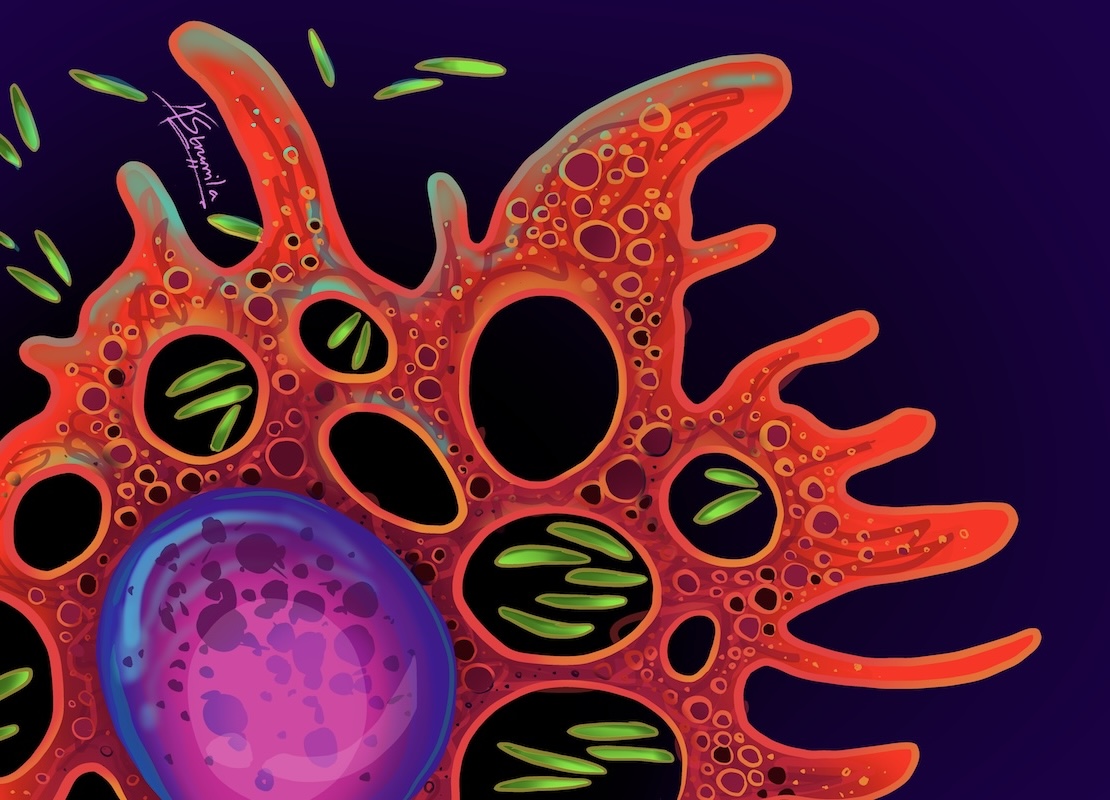
What we see under the microscope
This artwork below by Kathleen Strumila is Inspired by transmission electron microscopic imagery. It illustrates macrophages (red) as the immune system's vigilant "police," detecting and eliminating harmful invaders like mycobacteria (green),
More information
- Our team collaborates with the reNEW international consortium on numerous key projects from reNEW Melbourne and with our colleagues in Denmark and the Netherlands.
- New international stem cell research centre offers hope for patients with incurable diseases
- Global stem cell research partnership launches to advance treatment for incurable diseases
- Immune cell model paves the way for new treatments targeting common infection amongst immunocompromised children
- Human immune cells produced in a dish in world's first
Group Leaders
Team Leaders

Group Members




Our projects
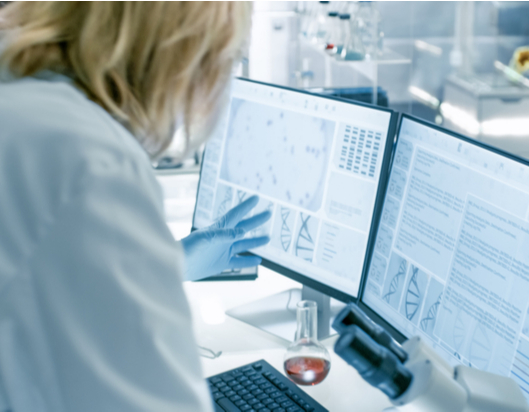
Stem cells and type 1 diabetes research
Exploring type 1 diabetes (T1D), immunity and autoimmunity. We are using pluripotent stem cell technology to examine the cause of T1D to develop potential treatments
Read more...Funding
- Novo Nordisk Foundation Center for Stem Cell Medicine, reNEW (Grant Number NNF21CC0073729)
- National Health and Medical Research Council (NHMRC)
- CSL Limited
- Diabetes Australia
- Breakthrough T1D
Collaborations
Collaborations with scientists at Murdoch Children’s Research Institute:
- Professor Andrew Elefanty
- Associate Professor Elizabeth Ng
- Associate Professor Shireen Lamande
- Associate Professor Dan Pellicci
- Dr Sohinee Sarkar
- Professor Sarath Ranganathan
- Dr Shivanthan Shanthikumar
- Dr Melanie Neeland
- Associate Professor Richard Mills
- Professor Andrew Steer
- Associate Professo Paul Licciardi
- Associate Professor Catherine Satzke
Other collaborators
- Stuart Mannering, St Vincent’s Institute of Medical Research, Melbourne, Australia
- Tom Kay, St Vincent’s Institute of Medical Research, Melbourne, Australia
- Helen Thomas, St Vincent’s Institute of Medical Research, Melbourne, Australia
- Tom Loudovaris, St Vincent’s Institute of Medical Research, Melbourne, Australia
- Josh Brickman, University of Copenhagen, Copenhagen, Denmark
- Eelco de Koning, Leiden University Medical Centre, Leiden, Netherlands
- Jakub Sedzinski, University of Copenhagen, Copenhagen, Denmark
Featured publications
Ng ES, Sarila G, Li JY, Edirisinghe HS, Saxena R, Sun S, Bruveris FF, Labonne T, Sleebs N, Maytum A, Yow RY, Inguanti C, Motazedian A, Calvanese V, Capellera-Garcia S, Ma F, Nim HT, Ramialison M, Bonifer C, Mikkola HKA, Stanley EG, Elefanty AG. Long-term engrafting multilineage hematopoietic cells differentiated from human induced pluripotent stem cells. Nat Biotechnol. 2025 Aug;43(8):1274-1287. doi: 10.1038/s41587-024-02360-7. Epub 2024 Sep 2. PMID: 39223325; PMCID: PMC12339382.
Schiesser JV, Yu Y, Loudovaris T, Thomas HE, Elefanty AG, Stanley EG. LY6H is a marker of human pancreatic delta cells. Sci Rep. 2025 Sep 26;15(1):33011. doi: 10.1038/s41598-025-18321-2. PMID: 41006592; PMCID: PMC12474887.
Sun S, Motazedian A, Li JY, Wijanarko K, Zhu JJ, Tharmarajah K, Strumila KA, Shkaruta A, Nigos LR, Schiesser JV, Yu Y, Neeson PJ, Ng ES, Elefanty AG, Stanley EG. Efficient generation of human NOTCH ligand-expressing haemogenic endothelial cells as infrastructure for in vitro haematopoiesis and lymphopoiesis. Nat Commun. 2024 Sep 4;15(1):7698. doi: 10.1038/s41467-024-51974-7. PMID: 39227582; PMCID: PMC11371830.
Sun S, See M, Nim HT, Strumila K, Ng ES, Hidalgo A, Ramialison M, Sutton P, Elefanty AG, Sarkar S, Stanley EG. Human pluripotent stem cell-derived macrophages host Mycobacterium abscessus infection. Stem Cell Reports. 2022 Sep 13;17(9):2156-2166. doi: 10.1016/j.stemcr.2022.07.013. Epub 2022 Aug 18. PMID: 35985333; PMCID: PMC9481898.
Labonne T, Elefanty AG, Stanley EG, Schiesser JV. An INSULIN-GFP/GLUCAGON-mCherry reporter line for the study of human pancreatic endocrine cell development. Stem Cell Res. 2021 Oct;56:102547. doi: 10.1016/j.scr.2021.102547. Epub 2021 Sep 28. PMID: 34619644.
Schiesser JV, Loudovaris T, Thomas HE, Elefanty AG, Stanley EG. Integrin αvβ5 heterodimer is a specific marker of human pancreatic beta cells. Sci Rep. 2021 Apr 15;11(1):8315. doi: 10.1038/s41598-021-87805-8. PMID: 33859325; PMCID: PMC8050092.
Motazedian A, Bruveris FF, Kumar SV, Schiesser JV, Chen T, Ng ES, Chidgey AP, Wells CA, Elefanty AG, Stanley EG. Multipotent RAG1+ progenitors emerge directly from haemogenic endothelium in human pluripotent stem cell-derived haematopoietic organoids. Nat Cell Biol. 2020 Jan;22(1):60-73. doi: 10.1038/s41556-019-0445-8. Epub 2020 Jan 6. PMID: 31907413.
Joshi K, Elso C, Motazedian A, Labonne T, Schiesser JV, Cameron F, Mannering SI, Elefanty AG, Stanley EG. Induced pluripotent stem cell macrophages present antigen to proinsulin-specific T cell receptors from donor-matched islet-infiltrating T cells in type 1 diabetes. Diabetologia. 2019 Dec;62(12):2245-2251. doi: 10.1007/s00125-019-04988-6. Epub 2019 Sep 12. PMID: 31511930; PMCID: PMC6861360.
Kao T, Labonne T, Niclis JC, Chaurasia R, Lokmic Z, Qian E, Bruveris FF, Howden SE, Motazedian A, Schiesser JV, Costa M, Sourris K, Ng E, Anderson D, Giudice A, Farlie P, Cheung M, Lamande SR, Penington AJ, Parish CL, Thomson LH, Rafii A, Elliott DA, Elefanty AG, Stanley EG. GAPTrap: A Simple Expression System for Pluripotent Stem Cells and Their Derivatives. Stem Cell Reports. 2016 Sep 13;7(3):518-526. doi: 10.1016/j.stemcr.2016.07.015. Epub 2016 Sep 1. PMID: 27594589; PMCID: PMC5032031.
Ng ES, Azzola L, Bruveris FF, Calvanese V, Phipson B, Vlahos K, Hirst C, Jokubaitis VJ, Yu QC, Maksimovic J, Liebscher S, Januar V, Zhang Z, Williams B, Conscience A, Durnall J, Jackson S, Costa M, Elliott D, Haylock DN, Nilsson SK, Saffery R, Schenke-Layland K, Oshlack A, Mikkola HK, Stanley EG, Elefanty AG. Differentiation of human embryonic stem cells to HOXA+ hemogenic vasculature that resembles the aorta-gonad-mesonephros. Nat Biotechnol. 2016 Nov;34(11):1168-1179. doi: 10.1038/nbt.3702. Epub 2016 Oct 17. PMID: 27748754.