Patient stories
Genomics solves diagnostic mystery
As a mum of seven, Miriam knows better than anyone what achieving early developmental milestones look like. Unlike the progress of her older children, Miriam’s daughter Gitty struggled with behavioural cues as a baby.
“We knew something was wrong within those first few months as she was lagging behind her peers and wasn’t developing like my older children,” Miriam said. She smiled later than her siblings, wouldn’t follow an object moving in front of her and seemed less alert and focused than other babies her age.”
But when Miriam and her husband Naphtaly took Gitty to a paediatrician, he wasn’t immediately concerned, advising them that delays were usually temporary and children could catch up quickly. Unfortunately Gitty never caught up with her peers. Her cognitive development was slow and she was diagnosed with low muscle tone which required physiotherapy.
At eight months old, Gitty underwent genomic testing for chromosomal abnormalities, genetic conditions that occur due to a problem with one of the 23 pairs of chromosomes. To Miriam’s relief, the tests came back negative, but the diagnostic questions remained.
“We continued testing for various conditions, but all the tests came back negative or inconclusive, so we still had no answers,” she said. As she got older, the gap with her peers widened and she was lagging further behind.”
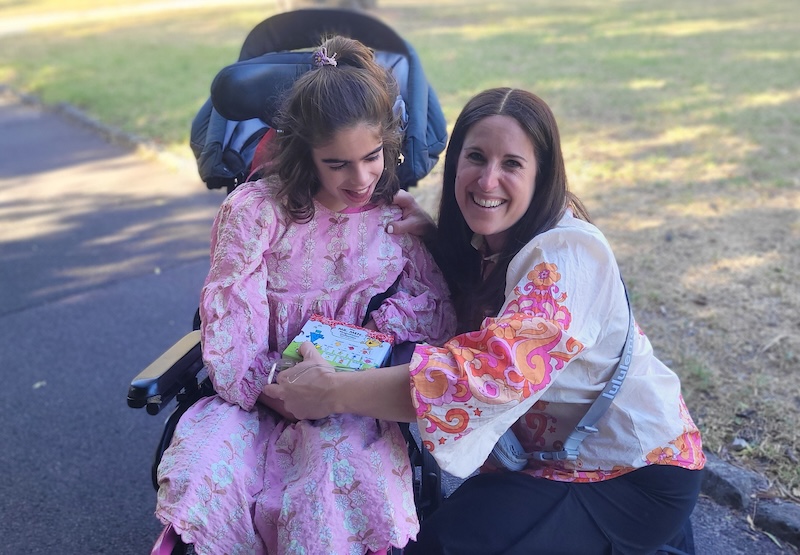
Image: Gitty and her mother, Miriam
In addition to cognitive impairment, Gitty had mobility issues, gross and fine motor delay and was nonverbal.
Miriam said it wasn’t until Gitty started having seizures at two years old that her path to a diagnosis began. Due to increasingly severe seizures, Gitty’s neurologist referred her to The Royal Children’s Hospital (RCH) where she was offered enrolment in the Rare Diseases Now (RDNow) program.
Drawing on research and clinical expertise at Murdoch Children's Research Institute (MCRI) and Victorian Clinical Genetics Services (VCGS), RDNow delivers genomic diagnoses and precise, personalised care to children. It also provides a pathway for children who remain undiagnosed after a genomic test by performing further testing if new genetic variants are later discovered.
Gitty underwent genomic testing with extended analyses under RDNow but the team was unable to pinpoint a specific genetic cause at the time. However, under the program participants consent to having their DNA reanalysed if new knowledge becomes available. About eight years later, Gitty’s family had the breakthrough they had been hoping for.
A global collaboration discovered that mutations in a gene called RNU2-2P causes a rare neurodevelopmental disorder (NDD) with epilepsy symptoms, which matched Gitty’s condition.
NDD causes severe impairments in how the brain functions that impact learning, behaviour, speech and movement. Most NDDs are thought to be genetic and caused by changes to DNA. But about 60 per cent of patients with these conditions don’t know the specific DNA change that caused their disorder.
VCGS Clinical Geneticist, MCRI Rare Disease Discovery Group Leader and RDNow Co-Lead Professor Tiong Tan met Miriam and Naphtaly late last year to discuss the diagnosis. He informed them that Gitty was one of only a few patients to be diagnosed with the rare disease, which was caused by a random genetic mutation and was not inherited from her parents.
“We felt very relieved when we found out,” Miriam said. The diagnosis didn’t change anything because Gitty was 10 years old at this stage and we’ve lived through all these symptoms. But knowing that it won’t affect our other children and can’t be passed down by them was a big relief. Uncertainty can be very unnerving, so having a diagnosis gives us peace of mind.”
Gitty’s epilepsy is mostly under control now and she is receiving treatments to ease her symptoms.
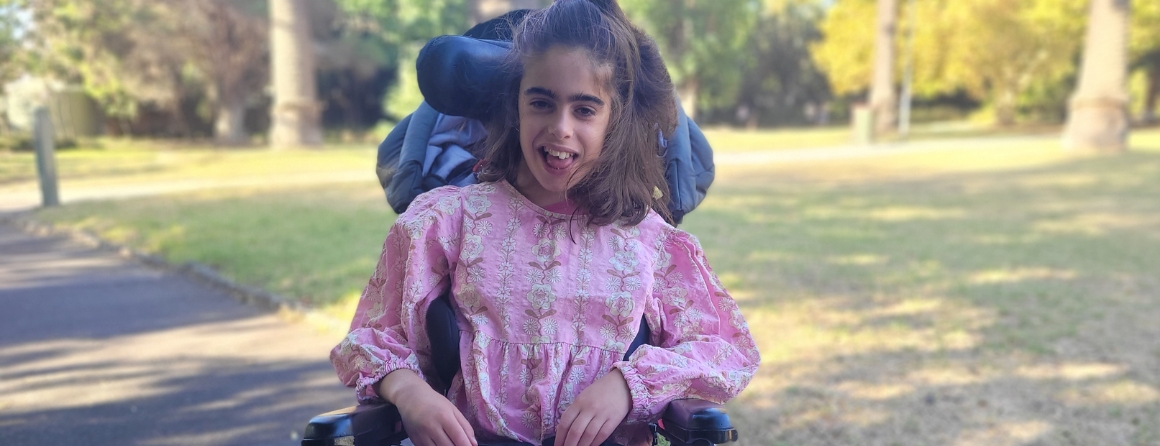
“With a lot of therapy, Gitty learned to walk at the age of four,”Miriam said. While she walks around the house, she uses a wheelchair most of the time when she's out.

Image: Gitty was diagnosed with a rare genetic disease
“Currently in Grade Six, she is excited to go to school every day and has a big smile on her face when she sees the school bus in the morning.”
After a decade-long diagnostic journey, Miriam and Naphtaly said they were hopeful about new discoveries that may help overcome health challenges for their daughter in the future.
“We feel like we can do something about it now,” Miriam said. Different treatments may become available down the track for her epilepsy and other symptoms that would make life so much easier for her.
“Before the diagnosis we were on our own, but now we can get support. We can contact other families, and knowing we’re not alone brings some validation.
“Gitty was given to us by God as a blessing. She's helped our family grow, taught us to love unconditionally and made us into better people.”
For more on the RDNow program.