Marking 40 years of discovery and impact
- Details
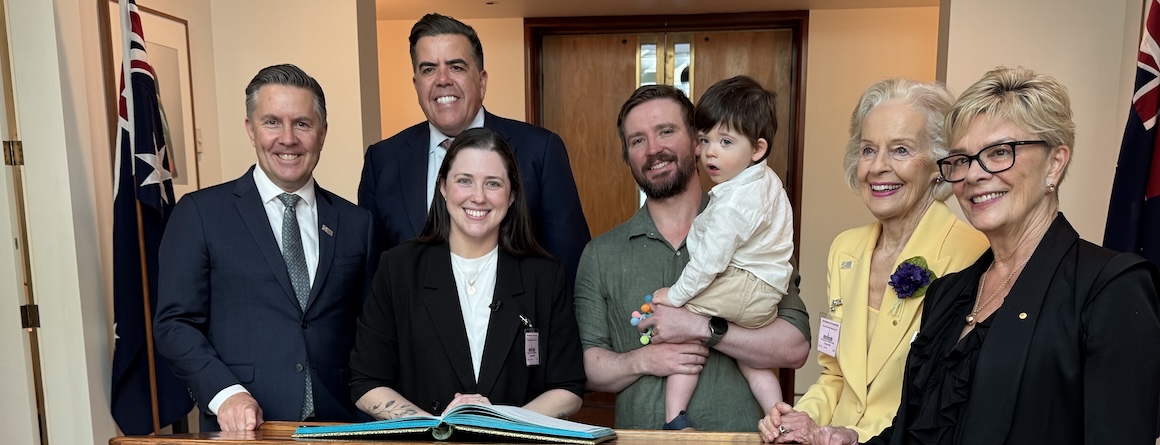
Murdoch Children’s Research Institute (MCRI) has marked four decades of pioneering discoveries and shaping child health policy during an event at Parliament House in Canberra.
MCRI Director Professor Kathryn North AC was joined today alongside Federal Health Minister Mark Butler, MP Dr Mike Freelander and Speaker of the House Milton Dick to help celebrate the Institute’s 40th anniversary.
More than 40 guests were in attendance to mark the milestone including Dame Quentin Bryce AD CVO, Senator Jana Stewart, Griffith MP Renee Coffey, Mackellar MP Dr Sophie Scamps, Australian Ambassador for Global Health Chris Cannan and Raising Children Network Director Derek McCormack.
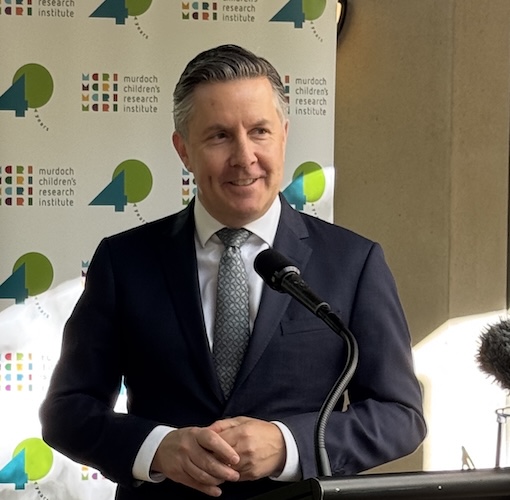
Image: Federal Health Minister Mark Butler
MCRI was also represented by its Chief Strategy Officer and GenV Executive Director Ben Fielding, Professor Sharon Goldfeld, Professor Mimi Tang, Professor John Christodoulou and Professor Frank Oberklaid.
MCRI was founded by Dame Elisabeth Murdoch with a vision to transform child health. On 17 February 1987, then Prime Minister Bob Hawke delivered a speech in Melbourne to launch the Murdoch Institute for Research into Birth Defects, which later became MCRI. Forty years on, MCRI is now one of the top three child health research institutes globally. This would not have been possible without the Federal Government.
Professor North told the crowd while MCRI had achieved remarkable results, it would continue to deliver the evidence that informed national policy priorities.
“Anniversaries are not just about looking back,” she said. “They are moments to reaffirm who we are, why we exist and where we are going next.
“Whether it’s Thriving Kids, the Early Years Strategy, helping to achieve a breakthrough medicine for dwarfism, enabling mitochondrial donation via Maeve’s Law or shepherding next generation gene therapies through trials into the clinic... you can be sure MCRI will continue to push forward the boundaries of what’s possible for children today, and the adults they will become in the future.”
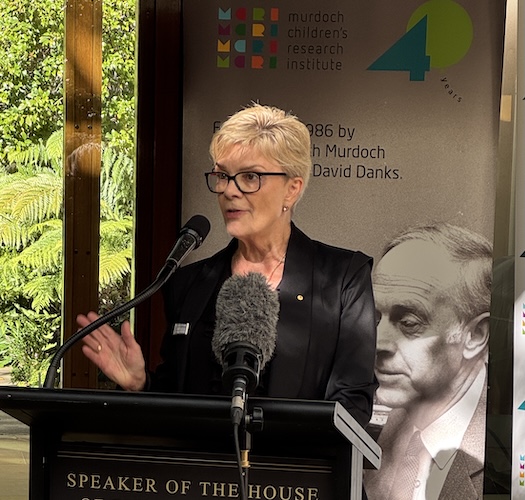
Image: Professor Kathryn North AC
The event also heard from Emma and Chris, whose son Archer, 2, has a severe genetic epilepsy. If left untreated, the condition can lead to epileptic encephalopathy, with significant developmental, cognitive and behavioural decline.
Emma said without an initial diagnosis Archer’s seizures progressively worsened with medication not effective in alleviating his symptoms.
But after Archer was enrolled in MCRI’s Gene-STEPS trial for babies with new-onset epilepsy, he received rapid genomic testing that diagnosed the exact genetic variation behind his condition. Gene-STEPS is supported by the MRFF Genomics Health Futures Fund.
Emma said the diagnosis meant his medication was immediately changed and his seizures dramatically dropped.
“We were lucky to be able to access the help we needed so quickly,” she said. “To go from Archer’s first really scary seizure, to ending up with the exact genetic diagnosis and having him being put on the right combination of medications for him within a couple of weeks, it’s huge.”
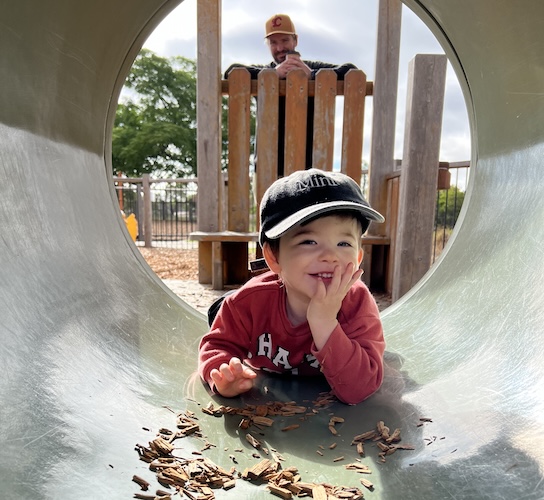
Image: Archer was diagnosed with SCN1A-Dravet syndrome
Emma said her family was privileged to help highlight MCRI’s 40-year legacy across child health research.
“We were only too happy to come up to Canberra and talk to parliamentarians about our family’s experience,” she said. “If we can play even a small part in helping raise awareness about MCRI’s incredible achievements so far and their vision for all our children’s future, it will be so worth it.”