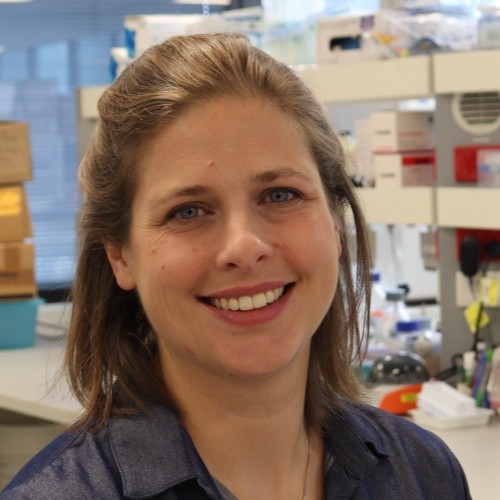
Dr Carolien van de Sandt
Dr Carolien van de Sandt
Details
Role
Team Leader/Senior Research Fellow
Research area
Infection, Immunity and Global Health
Group
Cellular Immunology
Dr Carolien van de Sandt is a Team Leader within the Cellular Immunology Group in the Infection, Immunity and Global Health Theme at the Murdoch Children’s Research Institute (MCRI) and an Honorary Senior Research Fellow in the Department of Microbiology and Immunology at the University of Melbourne (UoM). Her principal area of expertise is in viral immunology.
Carolien completed her PhD in 2016 at the Erasmus University in Rotterdam (the Netherlands) where she investigated the longevity, cross-reactivity and immune evasion strategies of influenza-specific CD8+ T-cells, followed by two years of postdoctoral research.
In 2018, she was awarded the prestigious European Marie Sklodowska-Curie Fellowship and the McKenzie Fellowship. She joined the Kedzierska laboratory at the University of Melbourne, where she led the Aging Immunity Research Program which aims to unravel the mechanisms that underly gain and loss of virus-specific CD8+ T-cell function across human lifespan. During the pandemic Carolien temporarily relocated to the Netherlands (2020-2021) where she led her own research team at Sanquin Research studying SARS-CoV-2 immunity in healthy and autoimmune patients. In 2022 she was awarded the ARC-DECRA Fellowship and the NHMRC Investigator EL2 Fellowship in 2025.
In 2025, Carolien established her own research group at the Murdoch Children’s Research Institute focusing on T cell development and restoring virus-specific immunity across the human lifespan, for which she was awarded the 2026-CSL Centenary Fellowship.
Carolien has >70 publications including in leading scientific journals like Nature Medicine, Immunity, Nature Immunology and Nature Communications. The importance of her work has been recognized by 11 prestigious Awards including the Australian and New Zealand Society for Immunology (ASI)-Peter Doherty Medal (2024), the European Scientific Working Group on Influenza (ESWI)-Claude Hannoun Prize for Best Body of Work (2023) and the UoM-MDHS Selwyn-Smith Medical Research Prize (2024). In 2023, she received the Australian Institute of Policy and Science (AIPS)-Young Tall Poppy Award and ASI-Public Engagement Award for her contributions to public outreach and in 2024 she was shortlisted for the Nature Inspiring Women: Scientific Achievement Award.
Carolien completed her PhD in 2016 at the Erasmus University in Rotterdam (the Netherlands) where she investigated the longevity, cross-reactivity and immune evasion strategies of influenza-specific CD8+ T-cells, followed by two years of postdoctoral research.
In 2018, she was awarded the prestigious European Marie Sklodowska-Curie Fellowship and the McKenzie Fellowship. She joined the Kedzierska laboratory at the University of Melbourne, where she led the Aging Immunity Research Program which aims to unravel the mechanisms that underly gain and loss of virus-specific CD8+ T-cell function across human lifespan. During the pandemic Carolien temporarily relocated to the Netherlands (2020-2021) where she led her own research team at Sanquin Research studying SARS-CoV-2 immunity in healthy and autoimmune patients. In 2022 she was awarded the ARC-DECRA Fellowship and the NHMRC Investigator EL2 Fellowship in 2025.
In 2025, Carolien established her own research group at the Murdoch Children’s Research Institute focusing on T cell development and restoring virus-specific immunity across the human lifespan, for which she was awarded the 2026-CSL Centenary Fellowship.
Carolien has >70 publications including in leading scientific journals like Nature Medicine, Immunity, Nature Immunology and Nature Communications. The importance of her work has been recognized by 11 prestigious Awards including the Australian and New Zealand Society for Immunology (ASI)-Peter Doherty Medal (2024), the European Scientific Working Group on Influenza (ESWI)-Claude Hannoun Prize for Best Body of Work (2023) and the UoM-MDHS Selwyn-Smith Medical Research Prize (2024). In 2023, she received the Australian Institute of Policy and Science (AIPS)-Young Tall Poppy Award and ASI-Public Engagement Award for her contributions to public outreach and in 2024 she was shortlisted for the Nature Inspiring Women: Scientific Achievement Award.
Dr Carolien van de Sandt is a Team Leader within the Cellular Immunology Group in the Infection, Immunity and Global Health Theme at the Murdoch Children’s Research Institute (MCRI) and an Honorary Senior Research Fellow in the Department of...
Dr Carolien van de Sandt is a Team Leader within the Cellular Immunology Group in the Infection, Immunity and Global Health Theme at the Murdoch Children’s Research Institute (MCRI) and an Honorary Senior Research Fellow in the Department of Microbiology and Immunology at the University of Melbourne (UoM). Her principal area of expertise is in viral immunology.
Carolien completed her PhD in 2016 at the Erasmus University in Rotterdam (the Netherlands) where she investigated the longevity, cross-reactivity and immune evasion strategies of influenza-specific CD8+ T-cells, followed by two years of postdoctoral research.
In 2018, she was awarded the prestigious European Marie Sklodowska-Curie Fellowship and the McKenzie Fellowship. She joined the Kedzierska laboratory at the University of Melbourne, where she led the Aging Immunity Research Program which aims to unravel the mechanisms that underly gain and loss of virus-specific CD8+ T-cell function across human lifespan. During the pandemic Carolien temporarily relocated to the Netherlands (2020-2021) where she led her own research team at Sanquin Research studying SARS-CoV-2 immunity in healthy and autoimmune patients. In 2022 she was awarded the ARC-DECRA Fellowship and the NHMRC Investigator EL2 Fellowship in 2025.
In 2025, Carolien established her own research group at the Murdoch Children’s Research Institute focusing on T cell development and restoring virus-specific immunity across the human lifespan, for which she was awarded the 2026-CSL Centenary Fellowship.
Carolien has >70 publications including in leading scientific journals like Nature Medicine, Immunity, Nature Immunology and Nature Communications. The importance of her work has been recognized by 11 prestigious Awards including the Australian and New Zealand Society for Immunology (ASI)-Peter Doherty Medal (2024), the European Scientific Working Group on Influenza (ESWI)-Claude Hannoun Prize for Best Body of Work (2023) and the UoM-MDHS Selwyn-Smith Medical Research Prize (2024). In 2023, she received the Australian Institute of Policy and Science (AIPS)-Young Tall Poppy Award and ASI-Public Engagement Award for her contributions to public outreach and in 2024 she was shortlisted for the Nature Inspiring Women: Scientific Achievement Award.
Carolien completed her PhD in 2016 at the Erasmus University in Rotterdam (the Netherlands) where she investigated the longevity, cross-reactivity and immune evasion strategies of influenza-specific CD8+ T-cells, followed by two years of postdoctoral research.
In 2018, she was awarded the prestigious European Marie Sklodowska-Curie Fellowship and the McKenzie Fellowship. She joined the Kedzierska laboratory at the University of Melbourne, where she led the Aging Immunity Research Program which aims to unravel the mechanisms that underly gain and loss of virus-specific CD8+ T-cell function across human lifespan. During the pandemic Carolien temporarily relocated to the Netherlands (2020-2021) where she led her own research team at Sanquin Research studying SARS-CoV-2 immunity in healthy and autoimmune patients. In 2022 she was awarded the ARC-DECRA Fellowship and the NHMRC Investigator EL2 Fellowship in 2025.
In 2025, Carolien established her own research group at the Murdoch Children’s Research Institute focusing on T cell development and restoring virus-specific immunity across the human lifespan, for which she was awarded the 2026-CSL Centenary Fellowship.
Carolien has >70 publications including in leading scientific journals like Nature Medicine, Immunity, Nature Immunology and Nature Communications. The importance of her work has been recognized by 11 prestigious Awards including the Australian and New Zealand Society for Immunology (ASI)-Peter Doherty Medal (2024), the European Scientific Working Group on Influenza (ESWI)-Claude Hannoun Prize for Best Body of Work (2023) and the UoM-MDHS Selwyn-Smith Medical Research Prize (2024). In 2023, she received the Australian Institute of Policy and Science (AIPS)-Young Tall Poppy Award and ASI-Public Engagement Award for her contributions to public outreach and in 2024 she was shortlisted for the Nature Inspiring Women: Scientific Achievement Award.
Top Publications
- Selva, KJ, van de Sandt, CE, Lemke, MM, Lee, CY, Shoffner, SK, Chua, BY, Nguyen, THO, Rowntree, LC, Hensen, L, Koutsakos, M, et al. Distinct systems serology features in children, elderly and COVID patients. 2026 view publication
- Dalit, L, Tan, CW, Sheikh, AA, Munnings, R, Howson, LJ, Alvarado, C, Hussain, T, Zaini, A, Cooper, L, Kirn, A, et al. Divergent cytokine and transcriptional signatures control functional T follicular helper cell heterogeneity.. Nat Immunol 26(10) : 1821 -1835 2025 view publication
- Menon, T, McQuilten, HA, Samir, J, Nguyen, THO, Lim, R, Kaur, J, Rizzetto, S, Eltahla, A, Thomas, PG, Lappas, M, et al. Central memory T cells with key TCR repertoires and gene expression profiles dominate influenza CD8+ T cell pools across the human lifespan.. Proc Natl Acad Sci U S A 122(30) : e2501167122 2025 view publication
- van de Sandt, CE, McQuilten, HA, Aban, M, Nguyen, THO, Valkenburg, SA, Grant, EJ, Sant, S, Rossjohn, J, Gras, S, Crowe, J, et al. Gradual changes within long-lived influenza virus-specific CD8+ T cells are associated with the loss of public TCR clonotypes in older adults.. EBioMedicine 115: 105697 2025 view publication
- van den Dijssel, J, Menon, T, McQuilten, HA, Eltherington, O, Gonzalez, A, Baghdasarian, S, Soemardy, C, Di Carlo, D, van Gisbergen, KPJM, Ten Brinke, A, et al. Linking Epitope-Specific T-Cell Receptors to IFNγ Secretion Using Nanovial Technology.. Eur J Immunol 55(5) : e202451666 2025 view publication
Page 1 of 16
Career information
Share //