Leveraging stem cell technology to combat cystic fibrosis superbugs
- Project status: Active
Research area: Infection, Immunity & Global Health > Respiratory
Harnessing the power of stem cell technology to develop advanced infection models to find new treatments for antibiotic resistant infections in people with cystic fibrosis (CF)
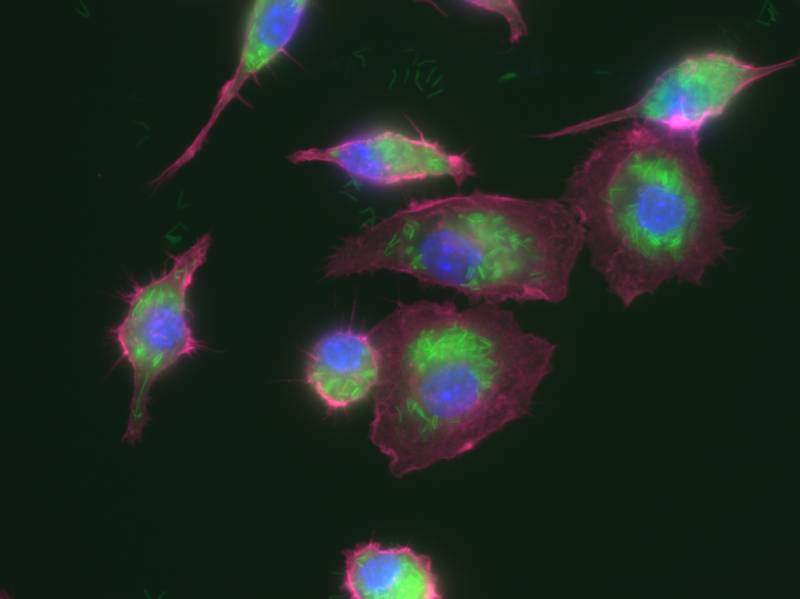
Image: Macrophage infection by Mycobacterium abscessus. The green-stained bacteria are actively engulfed by host immune cells (macrophages, shown in pink with blue nuclei), but survive and replicate inside them. Eventually, the bacteria cause the macrophages to burst, allowing the infection to spread to nearby cells.
Image captured by Dr Sohinee Sarkar.
Image: Macrophage infection by Mycobacterium abscessus. The green-stained bacteria are actively engulfed by host immune cells (macrophages, shown in pink with blue nuclei), but survive and replicate inside them. Eventually, the bacteria cause the...
Image: Macrophage infection by Mycobacterium abscessus. The green-stained bacteria are actively engulfed by host immune cells (macrophages, shown in pink with blue nuclei), but survive and replicate inside them. Eventually, the bacteria cause the macrophages to burst, allowing the infection to spread to nearby cells.
Image captured by Dr Sohinee Sarkar.
The challenge
Cystic fibrosis (CF) is the most common life-limiting genetic condition affecting the Australian population. There are over 3,500 patients (42 percent under the age of 18) on the Australian Cystic Fibrosis Data Registry (2023 data), with approximately 70 new diagnoses per year. CF causes thick, sticky mucus to build up in the lungs and airways, leading to frequent infections and inflammation.
While treatments for CF have improved significantly in recent years, infections caused by nontuberculous mycobacteria (NTM) remain especially difficult to treat. Additionally, NTM infections can affect anyone with an existing lung defect or a weakened immune system.
These infections often require children (and adults) to undergo long-term antibiotic therapy, daily doses that can last for months or even years. This intensive treatment can significantly reduce their quality of life.
Unfortunately, treatment can fail in more than 50 percent of cases, which can cause irreversible lung damage. There is an urgent need for safer, more effective therapies for young people living with CF.
Our research - Tackling a CF Superbug
Our team at MCRI has developed a world first model of macrophage-resident mycobacteria that can be scaled up for automation on our high-throughput drug screening platform.
This infection model is now allowing us to screen thousands of bioactive compounds against this infection in its natural physiological compartment where most traditional antibiotics cannot reach.
This pipeline is supported by robust stem cell–derived validation assays (lab tests that use human stem cell derived organ models to closely mimic how infections behave in the body). These assays help researchers predict how well potential treatments will work in real human tissues.
By integrating these models, we significantly improve the chances that shortlisted compounds will successfully translate into effective therapies for children with CF.
So far, we’ve screened over 4,000 clinically-used compounds and are now conducting in-depth analysis on the most promising candidates, bringing us closer to better treatment options for children with CF.
More information
- A-Z on Cystic Fibrosis
- Respiratory research group
- Infection, immunity & Global Health
- Stem Cell Medicine
Contact us
For more information about this project, please contact us.
Dr Sohinee Sarkar, Senior Research Officer
Email:
show email address
Phone:
show phone number
Cystic fibrosis news
Early lung damage mapped in children with cystic fibrosis

Preventing permanent hearing loss from antibiotic treatment using point-of-care genomic testing
Psychosocial determinants of health in infants & preschool children with cystic fibrosis (CF) diagnosed via newborn screening

Flourishing with a chronic condition

Dr Rhiannon Werder awarded Carty Signature Grant

Link between food allergies and eating disorders shown in children

Immune cell model paves way for new treatments targeting common infection amongst immunocompromised children
Epi-Genomic Newborn screening (EpiGNs) program
Cystic fibrosis

Share //