Observations to action program
- Project status: Active
Research area: Clinical Science > Paediatric Intensive Care (PICU)
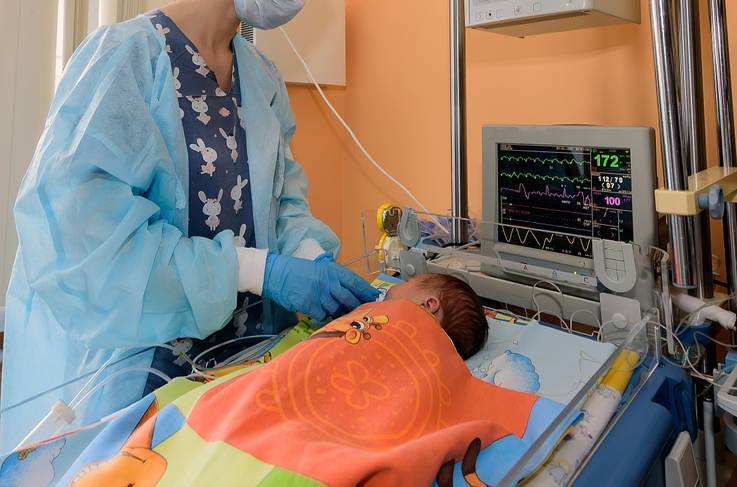
Real time vital sign monitoring for precise clinical decision making for children in intensive care
This program aims to harness signals from blood pressure and heart rate data in the sickest children to better inform precise decision making about therapies.
This project is seeking funding.
This program aims to harness signals from blood pressure and heart rate data in the sickest children to better inform precise decision making about therapies.
This project is seeking funding.
In paediatric intensive care, bedside monitors stream continuous vital sign data such as heart rate, blood pressure and oxygen levels that are crucial for care yet clinicians only view this information in snapshots.
Observations to Action, led by The Royal Children’s Hospital (RCH) Paediatric Intensive Care Unit (PICU) with the Murdoch Children’s Research Institute (MCRI), is building a real time data analytics platform that reads between every heartbeat to detect early warning signs of deterioration and personalise life-saving therapy for the sickest children.
Why this research matters
Severe infection (sepsis) and recovery from congenital heart surgery are leading reasons children require intensive care. In both, the failing heart and circulation are central. Many children depend on powerful continuous infusions of circulatory medications to keep blood flowing to vital organs. Getting the timing, dose and choice of these medications right is critical.
The novel component of this project is how we will use continuously recorded information about the heart and circulation to assist clinical decision making as care occurs. Bedside monitors record far more information than any clinician can interpret in real time, and important early signals of deterioration can go unrecognised. This program addresses that critical gap and investigates whether the real time analysis of vital signs can help clinicians act earlier and more precisely to improve outcomes.
What the program involves
The program brings together clinicians, data scientists, bioengineers and families to better understand how children respond to circulatory medications. It comprises three connected projects:
- Project 1: Understanding responses to treatment (2026) - Retrospective analysis of vital sign monitoring data already collected in our PICU, to study how children with septic shock respond to circulatory medications.
- Project 2: Real time heart function studies (2027–2029) - Prospective studies combining continuous monitoring with bedside heart ultrasound, allowing researchers and clinicians to observe how medications affect heart function to determine optimal treatments.
- Project 3: Predictive decision support tools (2029–2032) - Development and testing of traditional and machine learning models for their ability to improve assessment of the circulation and ultimately to develop decision support tools for clinicians in near real-time.
Information for families and participants
Who can take part?
Children admitted to the paediatric intensive care unit who require mechanical ventilation, have an arterial drip for blood pressure monitoring.
What does participation involve?
Participation includes:
- two brief, targeted heart ultrasounds before and after heart medications start
- secure collection of continuous vital sign data already recorded by bedside monitors for large scale quality and research projects
- use of routine clinical and laboratory information from the medical record.
Consent, privacy and safety
There are many ways we inform and seek permission from families regarding intensive care research. Written informed consent is obtained however, in urgent situations, deferred consent is used and families are approached as soon as appropriate. Participation is voluntary and can be withdrawn at any time without affecting a child’s care.
All data are treated like medical records; they are de-identified, securely stored on hospital servers, and never linked to individual children in publications. Families who would like to learn more can contact the RCH PICU Research Office.
How the research will be evaluated
The program uses rigorous statistical analytic methods to ensure findings are accurate and clinically meaningful. Evaluation also includes clinician feedback on usefulness and usability, family perspectives, and testing whether the tools improve decision making in real clinical settings.
Collaborators & funding
The program is hosted by the RCH PICU and MCRI, where the Principal Investigator holds a four year research fellowship. Key collaborators include the RCH Centre for Health Analytics, University of Melbourne bioengineering researchers, the RCH Bioengineering and Information Technology clinicians, and industry.
Philanthropic support will seed the data platform, project coordination and statistical capability that underpin all three projects. Early findings will support applications to the National Health and Medical Research Council (NHMRC) and the Medical Research Future Fund (MRFF).
Publications & future impact
Findings will be published in peer reviewed paediatric intensive care journals and presented at scientific meetings, with collaboration across PICUs nationally and internationally.
While focused on paediatric intensive care, the underlying analytics infrastructure is designed to scale across hospital services, improving care for critically ill children across Australia, New Zealand and worldwide.
Contact us
For more information on the program, please contact us.
Dr Ben Gelbart, Honorary Fellow Manager, PICU
Email: [email protected]
Phone:
show phone number
Latest news at MCRI
Introducing our 2025 Annual Report
Children at centre of stem cell research decisions with MRFF grant

Vale Patricia Ilhan

Genomic tool highly effective at detecting rare disease diagnoses

Social media use linked to poorer mental health in early adolescence

Safety concerns biggest barrier to vaccination

Accelerating recovery for children with concussion
Early lung damage mapped in children with cystic fibrosis

New network to make access to cutting-edge trials easier

MCRI’s 40th Anniversary Gala celebrates four decades of discovery

Protecting children receiving cancer treatment from infections

Multi-pronged plan to address childhood obesity crisis

Share //