Bioinformatics
Turning complex genomic data into answers for children with rare diseases, helping families receive faster and more accurate diagnoses.
The Bioinformatics group plays a critical role in supporting genomic research and clinical care for children with rare and complex diseases.
We build and run the specialised software and data platforms needed to analyse vast amounts of genetic information.
The challenges
Around one in 12 Australians live with a rare genetic disorder, and for many children, standard genomic testing still cannot find the cause of their condition.
Without answers, families face uncertainty about their child’s health, future treatment options and the risk to other family members.
Our work
We bridge the gap between clinicians, researchers and advanced technologies.
The human genome contains billions of data points, and identifying the single change responsible for disease requires sophisticated computational approaches.
We develop tools and methods that make this possible, ensuring cutting-edge genomic technologies can be used effectively in real-world healthcare.
Our work is often behind the scenes, but its impact is direct and meaningful: faster diagnoses, improved care, and better outcomes for children and their families.
By continuously improving our method, including the use of emerging technologies like long-read sequencing and artificial intelligence (AI), we aim to solve more previously unsolved cases and ensure that fewer families are left without answers.
Partnerships
We support major research and clinical programs across MCRI, including rare disease initiatives and collaborations with the Victorian Clinical Genetics Services (VCGS).
Our platforms allow researchers and clinicians to analyse and interpret genomic data more efficiently, accelerating the path to diagnosis.
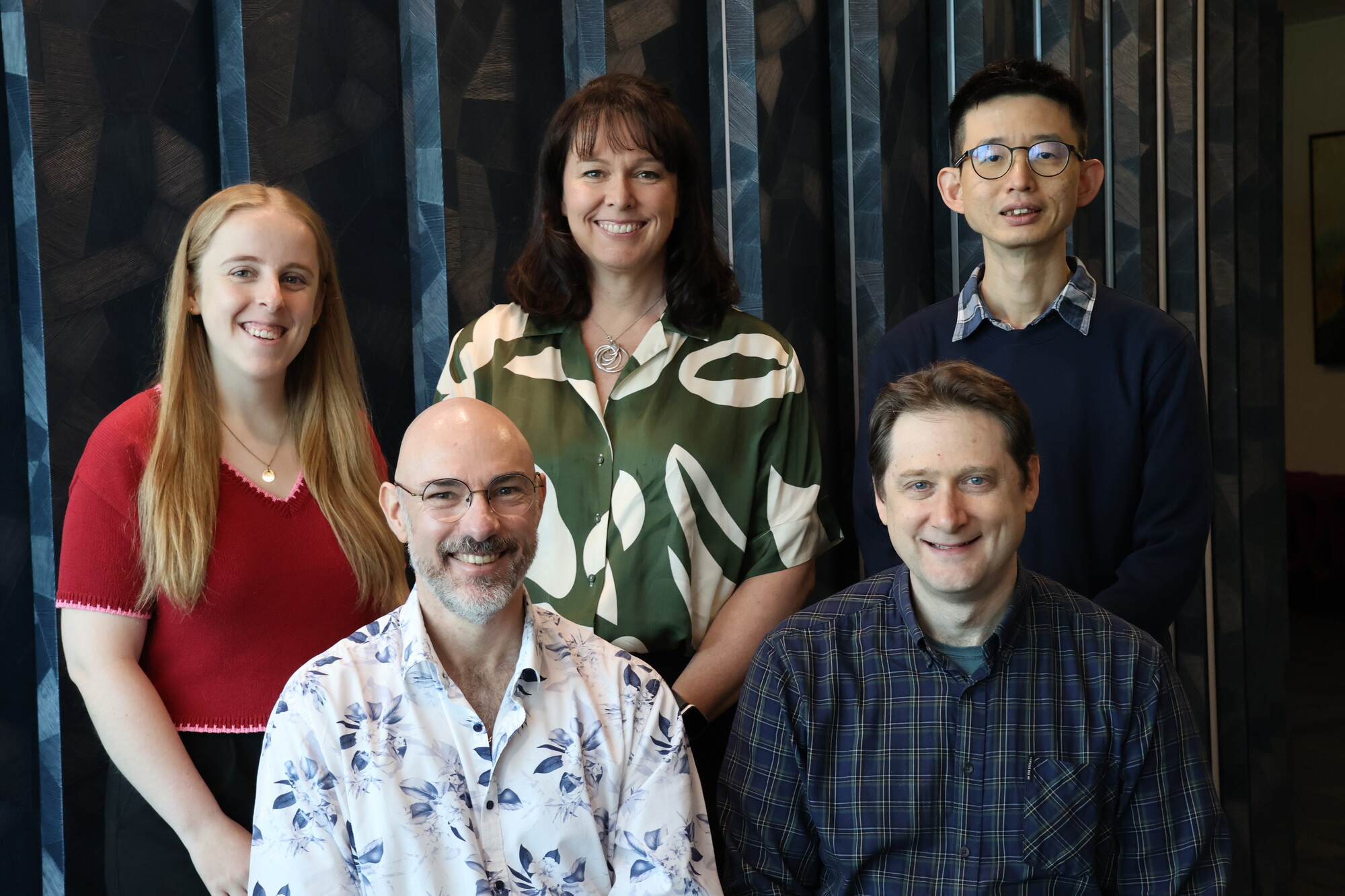
Image: MCRI Bioinformatics group (L-R) Monique Dunstan, Dr Tom Conway, Dr Katrina Bell, Dr Simon Sadedin and Dr Jimmy Chiu.
More information
Group Leaders

Team Leaders

Group Members



Our projects
The Bioinformatics groip continues to build, refine and operate the platforms that underpin MCRI’s rare-disease genomics work.
Seqr - the global genomic atlas
A web-based variant analysis and curation platform used by clinical geneticists and researchers. Originally developed by the Broad Institute in the United States, our team operates and extends a local Australian version. We integrate it with data analysis workflows and add bespoke analysis modules so that researchers and disease specialists can independently search and curate their own data.
Archie - a centralised, data tracking and cataloguing self-service data platform
Archie lets researchers across MCRI ingest, organise and re-analyse their cohort data without depending on a one-off bioinformatics project for every question. Archie has become the backbone for several large MCRI cohorts and is the platform where most new analysis pipelines are made available to researchers.
Mitoreport: Mitochondrial analysis
A purpose-built tool developed by the team for interpreting mitochondrial DNA variants — a class of rare disease that standard pipelines often miss.
Long-read sequencing workflows
A new analysis pipelines for long-read (Oxford Nanopore and PacBio) sequencing data. Long-reads are particularly important for finding the kinds of large structural variants and repeat-rich insertions that traditional genomic sequencing cannot resolve.
Bespoke analysis for unsolved cases
For families where standard process has already returned a negative result, the team partners with research projects such as RDNow to apply advanced methods (RNA sequencing, long read sequencing, proteomics, structural-variant detection, Matchmaker Exchange and gene-by-gene expert collaborations).
PanelApp Australia
Australia’s primary database of disease gene relationships, hosted online and used by clinical genetic testing laboratories around Australia as an authoritative source of knowledge for which genes to test for genetic disorders.
Funding
Thank you to our supporters.
- Miller Foundation
Collaborations
We partner with leading institutions worldwide, including:
- Victorian Clinical Genetics Services (VCGS)
- The Royal Children’s Hospital (RCH)
- Rare Diseases Now (RDNow)
- International Precision Child Health Partnership (IPCHiP)
- Gene-STEPS project
- MCRI Neurogenetics group, Bruce LeFroy Centre
- International rare disease and genomics partnerships
Key publications
Dominguez Gonzalez CA, Bell KM, Rajagopalan R, de Silva MG, Lemes A, Zabala C, Pérez-Vidarte F, Cerisola A, Vossough A, Whitehead MT, Cunningham C, Brown NJ, Quin R, Simons C, Conway T, Uebergang E, Rius R, Kumaheri MA, Kotes ER, Vohra A, Zalusky MPG, Anderson ZB, Storz SHR, Ward SA, Goffena J, Gustafson JA, White SM, Vanderver A, Miller DE. Deep Intronic SVA_E Insertion Identified as the Most Common Pathogenic Variant Associated With Canavan Disease: A Diagnostic Blind Spot. Neurol Genet. 2025 Sep 22;11(5):e200291. doi: 10.1212/NXG.0000000000200291. PMID: 40995055; PMCID: PMC12456746.
Sadedin SP, Oshlack A. Bazam: a rapid method for read extraction and realignment of high-throughput sequencing data. Genome Biol. 2019 Apr 18;20(1):78. doi: 10.1186/s13059-019-1688-1. PMID: 30999943; PMCID: PMC6472072.
Dashnow H, Lek M, Phipson B, Halman A, Sadedin S, Lonsdale A, Davis M, Lamont P, Clayton JS, Laing NG, MacArthur DG, Oshlack A. STRetch: detecting and discovering pathogenic short tandem repeat expansions. Genome Biol. 2018 Aug 21;19(1):121. doi: 10.1186/s13059-018-1505-2. PMID: 30129428; PMCID: PMC6102892.
Stark, Z, Lunke, S, Downie, L, Caruana, J, Kugenthiran, N, De Fazio, P, Hollizeck, S, Bouffler, S, Amor, D, Archibald, A, et al. Genomic newborn screening: feasibility, acceptability and clinical outcomes. 2026
Lunke S, Downie L, Caruana J, Kugenthiran N, De Fazio P, Hollizeck S, Bouffler SE, Amor DJ, Archibald AD, Bombard Y, Christodoulou J, Clausen M, Fagan W, Gaff C, Greaves RF, Gyngell C, Kanga-Parabia A, Lang N, Lee C, Lynch F, Marty A, Marty M, McGregor C, Riseley J, Sadedin S, Scarff K, da Cunha Torres M, Tutty E, Vang C, Wall M, Wong EM, Yeung A, Goranitis I, Best S, Vears DF, Stark Z. Feasibility, acceptability and clinical outcomes of the BabyScreen+ genomic newborn screening study. Nat Med. 2025 Dec;31(12):4236-4245. doi: 10.1038/s41591-025-03986-z. Epub 2025 Oct 9. PMID: 41068466; PMCID: PMC12705431.
Zhao, T, Fennell, AP, Sharma, T, Bell, KM, Dunstan, M, Lunke, S, McGrath, MJ, McLean, C, Undiagnosed Diseases Network (UDN‐Aus), Thorburn, DR, et al. Unraveling a Diagnostic Enigma: A TECPR2 Case Solved Through Multi-Omic Genomics.. Am J Med Genet A 2026
Tan, NB, Gautschi, M, Raum, M, Hock, DH, Kopajtich, R, Wang, J, Qian, X, Sharma, T, Green, TE, Nuoffer, J-M, et al. Bi-allelic variants in NDUFA5 cause a mitochondriopathy with complex I deficiency.. Am J Hum Genet 113(5) : 1108 -1121 2026
Kline, BL, Moran, IL, Cai, X, Siddall, NA, Wijaya, F, Dulon, J, Bakhshalizadeh, S, Bell, KM, Jaillard, S, Robevska, G, et al. RNA exosome component EXOSC10 variants identified in a patient with premature ovarian insufficiency†.. Biol Reprod 114(4) : 1416 -1428 2026
Atlas, G, Bell, KM, Robevska, G, van den Bergen, J, Hadiprajitno, PI, Listyasari, N, Santosa, A, Juniarto, AZ, Francis, DI, O Apos Connell, MA, et al. WT1 Deletion in 46,XY DSD: The Importance of Copy Number Variant Analysis.. Sex Dev 1 -12 2026
Rare disease news

Automated reanalysis in rare disease
Life with an ultra-rare condition

Associate Professor Katie Ayers awarded Rebecca Cooper Fellowship

NHMRC Ideas Grants to advance childhood treatments and diagnoses
Newborn genomic screening enables more lifesaving diagnoses

Genomic test unlocks brighter future

Rare Diseases Now (RDNow)

Precision therapies for life-threatening ultra-rare genetic diseases in children

Cybec Foundation funding for Associate Professor Katie Ayers

Searching for a rare disease diagnosis

Top genetics awards for Professor Daniel MacArthur and Dr Sylvia Metcalfe